Understanding Silent Churn: How AI Agents Help Distributors Respond Effectively
TLDR
- Silent churn occurs when customers gradually reduce orders or switch products without openly canceling, often going undetected until significant revenue is lost
- AI agents detect early warning signs and automatically generate personalized retention strategies at scale, providing account managers with complete action plans rather than just alerts
- The system learns which interventions work best for different customer segments, continuously improving retention strategies while requiring less human effort to execute
Silent churn is one of the most expensive problems distributors face, yet it often goes unnoticed until it’s too late. Unlike customers who openly cancel contracts or voice complaints, silent churners simply fade away—reducing order volumes, quietly switching to competitors, or replacing your products one SKU at a time.
The challenge isn’t just detecting these patterns. It’s responding to them quickly and intelligently across hundreds or thousands of customer relationships. This is where AI agents are fundamentally changing how distributors operate.
What Silent Churn Actually Looks Like
Silent churn manifests in several ways. A customer who consistently ordered 500 units monthly now orders 350. Another hasn’t reordered a previously regular product in six weeks. A third maintains overall purchasing frequency but has stopped buying three specific product lines.
These patterns are early warning signs. The customer may have found better pricing elsewhere, discovered a product they prefer, or simply received better service from a competitor. By the time these changes become obvious in quarterly reviews, the relationship has already shifted—often irreversibly.
The Response Challenge
Detecting order volume reductions is only half the battle. The real challenge is what happens next. With limited time and resources, how do you decide which situations need immediate attention? What’s the right intervention for each case? How do you personalize outreach across dozens of at-risk relationships simultaneously?
Traditional approaches struggle here. Sales teams receive alerts but lack the context and bandwidth to respond effectively. By the time someone researches the customer’s history, analyzes their purchasing patterns, and crafts an appropriate response, the moment for intervention may have passed.
How AI Agents Change the Response Equation
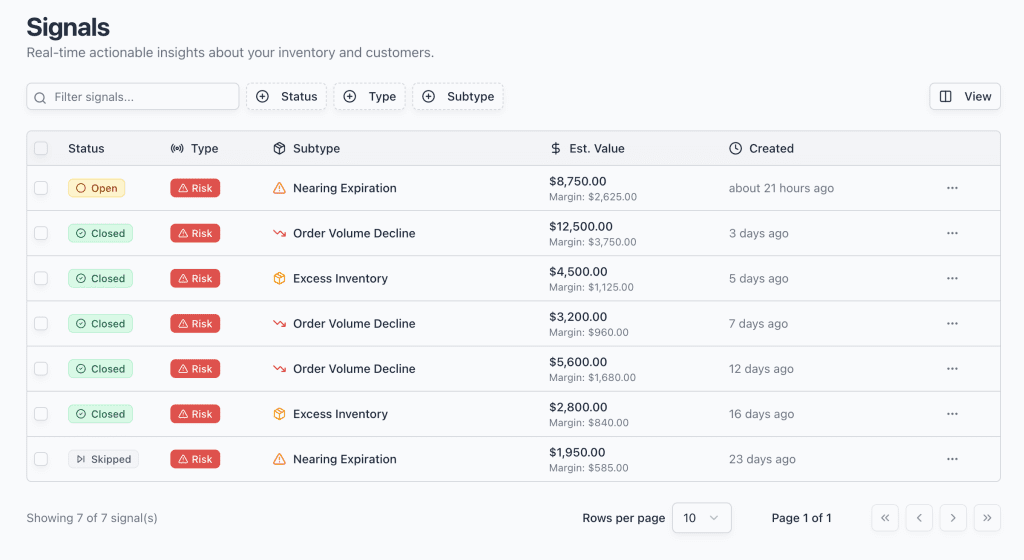
AI agents transform this process by orchestrating intelligent, personalized responses at scale. When the system detects order reduction or a potential product replacement, it doesn’t just flag the issue—it builds a complete response framework.
For a high-value customer showing early defection signs, the AI agent analyzes their purchase history, identifies the most likely causes, and recommends specific interventions. It might suggest scheduling a business review with a pre-built agenda highlighting at-risk product lines, propose competitive pricing adjustments based on market data, or identify alternative products in your catalog that better match their evolving needs.
The account manager receives not just an alert, but a complete action plan: context about what changed, why it matters, what similar customers responded to, and draft communications they can refine and send. What would take hours of research becomes minutes of review and execution.
Personalization at Scale
The real power emerges when you consider scale. An AI agent can simultaneously manage response workflows for dozens of at-risk relationships, each with tailored strategies based on customer value, relationship history, and the specific nature of the risk.
For price-sensitive customers, it might prioritize promotional offers. For relationship-driven accounts, it schedules personal outreach. For customers showing product-specific defection, it suggests alternatives or initiates quality discussions. Each response is calibrated to maximize the probability of retention while minimizing unnecessary discounting.
This isn’t possible with manual processes. A sales team can’t research and personalize interventions for fifty at-risk customers in a single day. An AI agent can, ensuring that every warning signal receives an appropriate, timely response rather than getting lost in the noise.
Continuous Improvement Through Learning
AI agents improve over time by tracking outcomes. Which retention strategies work best for which customer segments? What interventions have the highest success rates? Which warning signals predict actual churn versus temporary fluctuations?
This creates a feedback loop where your retention capabilities strengthen continuously. The system learns that proactive quality calls work well with manufacturing customers, that loyalty discounts are effective for volume buyers, or that business reviews prevent defection better than price adjustments for strategic accounts.
Over months and years, this accumulated knowledge becomes a competitive asset. Your retention strategies become increasingly sophisticated while requiring less human effort to execute.
Practical Implementation Patterns
Leading distributors typically implement AI agent responses through tiered workflows. Automated responses handle routine situations: check-in emails for minor order reductions, loyalty discounts for lapsed items, or reminder communications for irregular purchasing patterns.
Higher-value or more complex situations escalate to account managers—but with comprehensive briefings and recommended actions. The highest-tier cases might trigger executive involvement, again with full context and strategic recommendations prepared by the AI agent.
This approach ensures nothing falls through the cracks while focusing human expertise where it matters most. Your team isn’t wasting time on routine follow-ups or scrambling to research customer situations. They’re engaging in high-value conversations armed with complete information and proven strategies.
The Broader Strategic Impact
Beyond individual customer saves, AI-driven churn response provides strategic intelligence. Patterns across multiple customers reveal competitive threats, product weaknesses, or service gaps. If ten customers reduce orders on the same product line, that’s not ten isolated incidents—it’s a systematic issue requiring investigation.
This intelligence helps distributors address root causes, not just symptoms. You might discover a competitor aggressively targeting a specific segment, identify products needing specification updates, or recognize service delivery problems before they become widespread.
The AI agent surfaces these patterns automatically, connecting dots that would be invisible in customer-by-customer analysis. Decision makers gain visibility into market dynamics and competitive pressures in real-time rather than through delayed reporting cycles.
The Economics of Prevention
The financial case for AI-driven churn response is straightforward. Acquiring new customers costs significantly more than retaining existing ones. A single prevented defection of a mid-sized account often justifies months of technology investment.
More importantly, early intervention dramatically improves success rates. Reaching out when a customer has reduced orders by 30% is far more effective than waiting until they’ve reduced by 80%. At 30%, you’re addressing a problem. At 80%, you’re attempting a rescue.
AI agents enable this early intervention across your entire customer base, not just your top twenty accounts that receive white-glove attention anyway. The long tail of your customer relationships—accounts too small for dedicated management but collectively representing substantial revenue—gets the same proactive care as your strategic accounts.
Moving Forward
Silent churn won’t disappear. Customer expectations continue rising, competitive pressures intensify, and switching costs keep falling. What’s changing is the ability to respond effectively at scale.
AI agents provide distributors with tools to match the complexity of modern customer relationships—detecting problems early, orchestrating intelligent responses, and continuously improving retention strategies. The distributors adapting these capabilities are building sustainable advantages in customer retention that manual processes simply cannot replicate.
For decision makers, the path forward involves evaluating how AI agents can integrate into existing sales workflows, what data infrastructure enables effective implementation, and how quickly these capabilities can be deployed. The cost of inaction—continued silent churn draining revenue quarter after quarter—makes this evaluation increasingly urgent.
